Question 1. Explain Shannon’s Capacity Theorem and discuss its significance in determining the maximum achievable data rate of a communication channel.
Introduction
Shannon’s Capacity Theorem, also known as the Shannon-Hartley theorem, establishes the fundamental theoretical limit for the maximum data rate that can be transmitted over a communication channel with a specified bandwidth in the presence of noise.
Mathematical Formulation
The theorem is expressed as:

Key Insights
| Parameter | Effect on Capacity |
| Bandwidth (B) | Directly proportional - doubling bandwidth doubles capacity |
| Signal Power (S) | Logarithmic increase - requires exponential power increase |
| Noise (N) | Reduces capacity - minimizing noise is crucial |
Significance
- Theoretical Upper Bound: Provides the absolute maximum data rate achievable, regardless of modulation or coding techniques used.
- System Design Guidance: Engineers use this theorem to:
- Determine required bandwidth for target data rates
- Evaluate trade-offs between power and bandwidth
- Assess channel quality requirements
- Error-Free Communication: The theorem guarantees that error-free transmission is possible at rates below capacity using appropriate coding schemes.
- Modern Applications: Essential for designing cellular networks, Wi-Fi systems, and satellite communications where spectrum is limited.
Practical Implications
- 5G Networks: Achieves high data rates through massive MIMO and mmWave (higher bandwidth)
- Deep Space Communication: Relies on powerful error correction to approach Shannon limit
- Fiber Optics: Operates well below capacity due to extremely high S/N ratios
Question 2. Define information content and entropy. Explain how entropy measures the uncertainty of a source with suitable examples.
Information Content
Information content measures the amount of information conveyed by a message. It is inversely related to the probability of occurrence.
I(x) = -log₂[P(x)]
Where P(x) is the probability of message x occurring.
Key Characteristics:
- Rare events carry more information (higher I)
- Common events carry less information (lower I)
- Measured in bits (when using log₂)
Example:
- “The sun rose today” → Low information (high probability)
- “Earthquake detected” → High information (low probability)
Entropy
Entropy (H) represents the average information content or uncertainty of an information source. It quantifies the expected amount of information per symbol.
H(X) = -Σ P(xᵢ) × log₂[P(xᵢ)]
![Search Google Images: “entropy information theory formula”]
Entropy as Uncertainty Measure
| Scenario | Probability Distribution | Entropy | Interpretation |
| Certain outcome | [1, 0, 0] | 0 bits | No uncertainty |
| Fair coin | [0.5, 0.5] | 1 bit | Maximum uncertainty |
| Biased coin | [0.9, 0.1] | 0.47 bits | Reduced uncertainty |
| Uniform 8 symbols | [1/8 each] | 3 bits | Maximum for 8 symbols |
Examples
Example 1: Binary Source
- P(0) = 0.5, P(1) = 0.5
- H = -[0.5×log₂(0.5) + 0.5×log₂(0.5)] = 1 bit/symbol
Example 2: Biased Source
- P(0) = 0.8, P(1) = 0.2
- H = -[0.8×log₂(0.8) + 0.2×log₂(0.2)] = 0.72 bits/symbol
Significance
- Source Coding: Determines minimum bits needed for lossless compression
- Channel Capacity: Related to maximum transmission rate
- Cryptography: Higher entropy means better security
Question 3. Describe source coding and channel coding techniques. Compare their roles in efficient and reliable data transmission.
Source Coding
Source coding (data compression) aims to reduce redundancy in the source data to achieve efficient representation.
Objectives:
- Minimize average code length
- Remove statistical redundancy
- Enable efficient storage and transmission
Common Techniques:
| Technique | Type | Application |
| Huffman Coding | Lossless | Text compression |
| Arithmetic Coding | Lossless | JPEG, MP3 |
| LZW (Lempel-Ziv-Welch) | Lossless | GIF, ZIP files |
| Run-Length Encoding | Lossless | Fax, BMP |
| Transform Coding | Lossy | JPEG, MPEG |
Example - Huffman Coding: Symbols: A(0.5), B(0.25), C(0.125), D(0.125)
- A = 0, B = 10, C = 110, D = 111
- Average length = 1.75 bits (vs 2 bits for fixed-length)
Channel Coding
Channel coding adds controlled redundancy to enable error detection and correction during transmission.
Objectives:
- Detect and correct transmission errors
- Improve reliability over noisy channels
- Maintain data integrity
Common Techniques:
| Technique | Capability | Application |
| Parity Check | Single error detection | Simple systems |
| Hamming Code | Single error correction | RAM, satellites |
| CRC (Cyclic Redundancy Check) | Error detection | Ethernet, storage |
| Convolutional Code | Multiple error correction | Mobile phones |
| Reed-Solomon | Burst error correction | CDs, DVDs, QR codes |
| Turbo Codes | Near-Shannon limit | 3G/4G, deep space |
| LDPC Codes | High performance | Wi-Fi, 5G, DVB |
Comparison
| Aspect | Source Coding | Channel Coding |
| Purpose | Remove redundancy | Add redundancy |
| Goal | Efficiency | Reliability |
| Result | Reduced data size | Increased data size |
| Errors | Cannot handle errors | Corrects errors |
| Location | Before transmission | During transmission |
| Trade-off | Compression ratio | Coding rate vs. correction |
Combined Application
Modern communication systems use both coding types:
- Source coding compresses data (e.g., MP3 for audio)
- Channel coding protects against errors (e.g., Reed-Solomon)
Question 4. Explain the architecture and working of WLAN and Wi-Fi. Discuss their standards, advantages, and applications.
Wireless LAN (WLAN) Overview
WLAN provides wireless network connectivity within a limited geographic area using radio frequency technology.

WLAN Architecture Components
1. Infrastructure Mode
- Access Point (AP): Central coordinator
- Stations (STAs): Wireless client devices
- Distribution System (DS): Connects multiple APs
- Basic Service Set (BSS): Single AP coverage area
2. Ad-hoc Mode
- Direct device-to-device communication
- No central access point required
- Used for temporary networks
Wi-Fi Standards (IEEE 802.11)
| Standard | Year | Frequency | Max Data Rate | Range |
| 802.11b | 1999 | 2.4 GHz | 11 Mbps | ~100m |
| 802.11a | 1999 | 5 GHz | 54 Mbps | ~50m |
| 802.11g | 2003 | 2.4 GHz | 54 Mbps | ~100m |
| 802.11n | 2009 | 2.4/5 GHz | 600 Mbps | ~250m |
| 802.11ac | 2013 | 5 GHz | 6.93 Gbps | ~100m |
| 802.11ax (Wi-Fi 6) | 2019 | 2.4/5 GHz | 9.6 Gbps | ~250m |
| 802.11be (Wi-Fi 7) | 2024 | 2.4/5/6 GHz | 46 Gbps | ~250m |
Working Principle
- Association: Device connects to AP using SSID
- Authentication: Security verification (WPA2/WPA3)
- Data Transmission: CSMA/CA protocol manages access
- Frame Exchange: RTS/CTS mechanism prevents collisions
Advantages
| Advantage | Description |
| Mobility | Users can move freely within coverage |
| Easy Installation | No cabling required |
| Scalability | Easy to add new devices |
| Cost-Effective | Reduced infrastructure costs |
| Flexibility | Supports multiple device types |
Applications
- Home Networks: Internet connectivity for smart devices
- Enterprise: Office wireless infrastructure
- Education: Campus-wide network access
- Healthcare: Mobile patient monitoring
- Retail: POS systems and inventory management
- Public Spaces: Airports, hotels, cafes (Hotspots)
Question 5. Describe Bluetooth technology in detail, including its protocol stack, features, and typical use cases.
Introduction
Bluetooth is a short-range wireless communication technology designed for low-power, low-cost connectivity between devices.
Key Features
| Feature | Specification |
| Frequency Band | 2.4 GHz ISM |
| Range | 10m (Class 2), 100m (Class 1) |
| Data Rate | Up to 3 Mbps (Classic), 2 Mbps (LE) |
| Power Consumption | Very low (especially BLE) |
| Topology | Point-to-point, Star, Mesh |
| Devices per Network | Up to 8 active (Classic), unlimited (Mesh) |
Bluetooth Protocol Stack

Core Protocols:
- Radio Layer
- Physical layer specifications
- Frequency hopping spread spectrum (FHSS)
- 79 channels (1 MHz spacing)
- Baseband Layer
- Manages physical links
- Error correction and encryption
- Packet formatting
- Link Manager Protocol (LMP)
- Link setup and authentication
- Power management
- Quality of Service
- Logical Link Control and Adaptation (L2CAP)
- Protocol multiplexing
- Segmentation and reassembly
- Quality of Service
- Service Discovery Protocol (SDP)
- Device capability discovery
- Service registration
- Higher Layer Protocols
- RFCOMM: Serial port emulation
- OBEX: Object exchange
- ATT/GATT: Attribute protocol (BLE)
Bluetooth Versions Evolution
| Version | Year | Key Features |
| 1.0 | 1999 | Basic functionality |
| 2.0 + EDR | 2004 | Enhanced Data Rate (3 Mbps) |
| 3.0 + HS | 2009 | High Speed (24 Mbps with Wi-Fi) |
| 4.0 | 2010 | Bluetooth Low Energy (BLE) |
| 5.0 | 2016 | 2x speed, 4x range, 8x broadcasting |
| 5.3 | 2021 | Improved security, lower latency |
Typical Use Cases
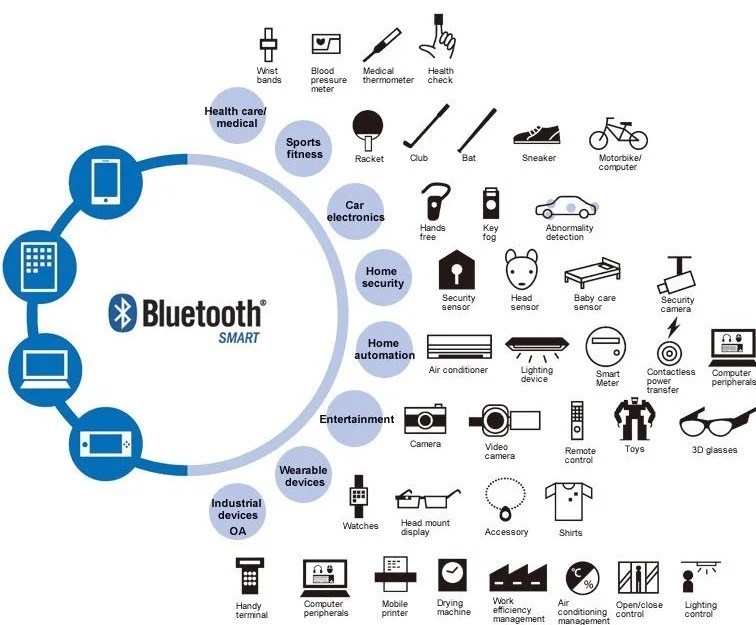
| Category | Applications |
| Audio | Wireless headphones, speakers, hearing aids |
| Input Devices | Keyboards, mice, game controllers |
| Wearables | Fitness trackers, smartwatches |
| Healthcare | Heart rate monitors, glucose meters |
| Automotive | Hands-free calling, OBD diagnostics |
| Smart Home | Locks, lights, thermostats |
| Industrial | Asset tracking, sensor networks |
Bluetooth Low Energy (BLE)
- Ultra-low power: Years on coin cell battery
- Quick connection: < 3 ms setup
- Small packets: Optimized for intermittent data
- Applications: IoT, beacons, health monitors
Question 6. Describe the LTE (4G) network architecture and its key technologies. Explain how LTE achieves higher data rates and improved quality of service compared to GSM and UMTS.
Introduction
Long-Term Evolution (LTE) is a standard for high-speed wireless communication that provides significant improvements over 3G UMTS.
![Search Google Images: “LTE network architecture diagram”]
LTE Network Architecture
1. Evolved Packet Core (EPC)
The all-IP core network with flat architecture:
| Component | Function |
| MME (Mobility Management Entity) | Signaling, authentication, mobility |
| S-GW (Serving Gateway) | User data routing, mobility anchor |
| P-GW (PDN Gateway) | IP allocation, policy enforcement |
| HSS (Home Subscriber Server) | User profile database |
| PCRF (Policy and Charging Rules) | QoS policy, billing rules |
2. Evolved UTRAN (E-UTRAN)
The radio access network:
| Component | Function |
| eNodeB (evolved Node B) | Radio resource management, scheduling |
| UE (User Equipment) | Mobile devices, modems |
Key LTE Technologies

1. OFDMA (Downlink)
- Orthogonal Frequency Division Multiple Access
- Divides channel into multiple subcarriers
- High spectral efficiency
- Resistant to multipath fading
2. SC-FDMA (Uplink)
- Single Carrier FDMA
- Lower peak-to-average power ratio
- Better battery life for mobile devices
3. MIMO (Multiple Input Multiple Output)
- Multiple antennas at transmitter and receiver
- Spatial multiplexing increases throughput
- Supports up to 8x8 MIMO in LTE-Advanced
4. Flat Architecture
- Direct connection between eNodeB and EPC
- Reduced latency (10-50 ms)
- Simplified network management
Performance Comparison
| Parameter | GSM (2G) | UMTS (3G) | LTE (4G) |
| Peak Data Rate | 9.6 kbps - 384 kbps | 2 Mbps - 42 Mbps | 100-300 Mbps |
| Latency | 600-800 ms | 100-500 ms | 10-50 ms |
| Switching | Circuit + Packet | Circuit + Packet | All-IP Packet |
| Spectrum Efficiency | Low | Medium | High |
| Architecture | Complex | Complex | Flat/Simplified |
| Voice | Circuit-switched | Circuit-switched | VoLTE (packet) |
QoS Improvements in LTE
| Feature | Implementation |
| Bearer-based QoS | Dedicated bearers for different services |
| Guaranteed Bit Rate | For real-time applications |
| Priority Handling | Emergency calls get priority |
| Seamless Mobility | Handover without interruption |
Advantages Over GSM/UMTS
- Higher Data Rates: 100x faster than 3G
- Lower Latency: Enables real-time gaming, video calls
- All-IP Network: Simplified architecture, lower costs
- Better Spectrum Efficiency: More users per MHz
- Flexible Bandwidth: 1.4, 3, 5, 10, 15, 20 MHz channels
Question 7. Discuss multimedia data and data processing techniques. Explain how different types of multimedia data are represented and transmitted over the Internet.
Introduction to Multimedia Data
Multimedia refers to content that uses multiple forms of media including text, audio, images, video, and animation.

Types of Multimedia Data
| Type | Characteristics | Data Rate |
| Text | ASCII/Unicode, highly compressible | Very low |
| Audio | Sampled sound waves | 64-1411 kbps |
| Images | Static pixel arrays | High (uncompressed) |
| Video | Sequential frames | Very high |
| Animation | Computer-generated frames | Variable |
Data Representation
1. Text
- ASCII: 7-bit encoding (128 characters)
- Unicode: 16-bit encoding (multilingual support)
- Compression: Huffman, LZW
2. Audio
- Sampling: Converting analog to digital
- Quantization: Assigning discrete values
- Formats: WAV (uncompressed), MP3 (lossy), FLAC (lossless)
![Search Google Images: “audio sampling quantization diagram”]
3. Images
- Raster: Pixel-based (JPEG, PNG, GIF)
- Vector: Mathematical descriptions (SVG)
- Color Models: RGB, CMYK, HSV
4. Video
- Frame Sequences: 24-60 fps typical
- Compression: Temporal and spatial redundancy removal
- Formats: MPEG, H.264, H.265 (HEVC)
Data Processing Techniques
| Technique | Purpose | Example |
| Compression | Reduce file size | JPEG for images, MP3 for audio |
| Streaming | Real-time playback | YouTube, Netflix |
| Transcoding | Format conversion | Converting AVI to MP4 |
| Encryption | Security | DRM for protected content |
| Watermarking | Copyright protection | Invisible image watermarks |
Internet Transmission

Protocols for Multimedia:
| Protocol | Function |
| RTP (Real-time Transport) | Packet delivery for audio/video |
| RTCP (RTP Control) | Quality feedback |
| RTSP (Real-time Streaming) | Stream control (play, pause) |
| HTTP Live Streaming (HLS) | Adaptive bitrate streaming |
| DASH (Dynamic Adaptive) | MPEG standard for streaming |
Transmission Methods:
- Progressive Download
- File downloads while playing
- Simple but not adaptive
- Adaptive Streaming
- Multiple quality levels
- Adjusts to network conditions
- Examples: Netflix, YouTube
- Peer-to-Peer (P2P)
- Users share content
- Reduces server load
- Example: BitTorrent
Challenges in Multimedia Transmission
| Challenge | Solution |
| High Bandwidth | Compression, caching, CDNs |
| Latency Sensitivity | QoS prioritization, buffering |
| Jitter | Playback buffers, timestamps |
| Synchronization | Lip-sync protocols |
| Heterogeneous Devices | Transcoding, multiple formats |
Question 8. Explain various modulation schemes used in digital communication and discuss their advantages and limitations.
Introduction
Digital modulation converts digital data into analog signals suitable for transmission over communication channels.
Types of Modulation
1. Amplitude Shift Keying (ASK)
Principle: Varies carrier amplitude based on data
| Aspect | Description |
| Binary ASK | Two amplitude levels (On-Off Keying) |
| M-ary ASK | Multiple amplitude levels |
| Bandwidth | (1+α) × Rb |
Advantages:
- Simple implementation
- Low cost
Limitations:
- Poor noise immunity
- Not suitable for wireless
- Power inefficient
2. Frequency Shift Keying (FSK)
Principle: Varies carrier frequency based on data
| Aspect | Description |
| Binary FSK | Two frequencies for 0 and 1 |
| M-ary FSK | Multiple frequencies |
| Bandwidth | 2Δf + 2Rb |
Advantages:
- Better noise immunity than ASK
- Constant envelope (power efficient)
- Simple detection
Limitations:
- Higher bandwidth requirement
- Spectral inefficiency
3. Phase Shift Keying (PSK)
Principle: Varies carrier phase based on data
![Search Google Images: “PSK QAM constellation diagram”]

| Type | States | Bits/Symbol |
| BPSK | 2 | 1 |
| QPSK | 4 | 2 |
| 8-PSK | 8 | 3 |
| 16-PSK | 16 | 4 |
Advantages:
- Excellent noise immunity
- Bandwidth efficient
- Constant envelope
Limitations:
- Higher-order PSK requires precise synchronization
- Performance degrades with phase noise
4. Quadrature Amplitude Modulation (QAM)
Principle: Modulates both amplitude and phase
| Type | States | Bits/Symbol |
| 16-QAM | 16 | 4 |
| 64-QAM | 64 | 6 |
| 256-QAM | 256 | 8 |
| 1024-QAM | 1024 | 10 |
Advantages:
- Highest spectral efficiency
- Supports very high data rates
- Used in modern systems (Wi-Fi, LTE)
Limitations:
- Requires high S/N ratio
- Complex transmitter/receiver
- Sensitive to channel impairments
5. Orthogonal Frequency Division Multiplexing (OFDM)
Principle: Multiple subcarriers transmitted simultaneously
Advantages:
- Excellent multipath resistance
- High spectral efficiency
- Simple equalization
Limitations:
- High peak-to-average power ratio
- Sensitive to frequency offset
- Requires precise synchronization
Comparison Summary
| Scheme | Spectral Efficiency | Noise Immunity | Complexity | Applications |
| ASK | Low | Poor | Low | Optical fiber |
| FSK | Low | Good | Low | Bluetooth, paging |
| BPSK | Low | Excellent | Low | Satellite, deep space |
| QPSK | Medium | Very Good | Medium | CDMA, satellite |
| 16-QAM | High | Good | Medium | Wi-Fi, cable |
| 64-QAM | Very High | Moderate | High | LTE, Wi-Fi |
| 256-QAM | Excellent | Fair | Very High | 5G, Wi-Fi 6 |
| OFDM | Excellent | Good | High | Wi-Fi, LTE, 5G |
Modern Applications
| Technology | Modulation Used |
| Wi-Fi (802.11) | OFDM, 64/256/1024-QAM |
| LTE | OFDMA, 64/256-QAM |
| 5G NR | OFDM, up to 256-QAM |
| DVB-T | OFDM, QPSK/16-QAM/64-QAM |
| Bluetooth | GFSK, π/4-DQPSK |
Question 9. Explain Wireless PAN and WAN technologies. Compare their characteristics, coverage, and applications.
Introduction
Wireless networks are classified by coverage area: PAN (Personal Area Network) and WAN (Wide Area Network) represent opposite ends of the spectrum.

Wireless Personal Area Network (WPAN)
Characteristics:
- Range: 1-10 meters (up to 100m for some technologies)
- Data Rate: Low to medium (up to a few Mbps)
- Power: Very low consumption
- Cost: Inexpensive devices
Technologies:
| Technology | Range | Data Rate | Applications |
| Bluetooth | 10-100m | 3 Mbps | Audio, peripherals |
| Zigbee | 10-100m | 250 kbps | Home automation, sensors |
| NFC | < 10cm | 424 kbps | Contactless payment |
| UWB | 10m | 480 Mbps | Precision location |
| IrDA | 1m | 4 Mbps | Remote controls (legacy) |
Applications:
- Wireless peripherals (mouse, keyboard)
- Health monitoring devices
- Smart home automation
- Personal audio devices
Wireless Wide Area Network (WWAN)
Characteristics:
- Range: City-wide to global coverage
- Data Rate: Medium to high (Mbps to Gbps)
- Infrastructure: Requires cellular towers
- Cost: Higher subscription costs
Technologies:
| Generation | Technology | Data Rate | Coverage |
| 2G | GSM/GPRS/EDGE | 9.6 kbps - 384 kbps | Global |
| 3G | UMTS/HSPA | 2-42 Mbps | Wide area |
| 4G | LTE/LTE-A | 100-1000 Mbps | Wide area |
| 5G | NR | 1-10 Gbps | Dense deployment |
| Satellite | Various | Up to 100 Mbps | Global |
| WiMAX | 802.16 | Up to 1 Gbps | Metropolitan |
Applications:
- Mobile broadband internet
- Voice and video calling
- IoT connectivity (LPWAN)
- Emergency communications
Comparison: WPAN vs WWAN
| Feature | WPAN | WWAN |
| Coverage | Personal space (meters) | Wide area (km to global) |
| Data Rate | Low-Medium | Medium-High |
| Latency | Very low (< 10ms) | Higher (10-100ms) |
| Power | Very low (mW) | Higher (hundreds of mW) |
| Infrastructure | Minimal/None | Extensive (towers, backhaul) |
| Cost | Low device cost | Subscription + device cost |
| Mobility | Limited | Full mobility support |
| Spectrum | Unlicensed (ISM) | Licensed spectrum |
| Use Case | Device connectivity | Internet access on-the-go |
Complementary Technologies
Modern devices integrate multiple wireless technologies:
| Device | WPAN | WLAN | WWAN |
| Smartphone | Bluetooth, NFC | Wi-Fi | 4G/5G |
| Laptop | Bluetooth | Wi-Fi | Optional 4G/5G |
| Smartwatch | Bluetooth | Wi-Fi | Optional LTE |
| IoT Sensor | Zigbee/Z-Wave | Wi-Fi | NB-IoT/LTE-M |
Question 10. Discuss satellite communication systems. Explain their components, working principles, and advantages and disadvantages.
Introduction
Satellite communication uses artificial satellites in Earth’s orbit to relay signals between distant points on the ground.

Components of Satellite Communication
1. Space Segment
| Component | Description |
| Satellite | Orbiting spacecraft with transponders |
| Transponder | Receives, amplifies, and retransmits signals |
| Antennas | Receive and transmit signals |
| Power System | Solar panels and batteries |
| Control System | Maintains orbit and attitude |
2. Ground Segment
| Component | Description |
| Earth Station | Ground-based transmission/reception facility |
| Antenna | Large parabolic dishes (up to 30m) |
| Transmitter | High-power amplifiers (kW range) |
| Receiver | Low-noise amplifiers |
| Control Center | Network management and monitoring |
Satellite Orbits
| Orbit Type | Altitude | Period | Applications |
| LEO (Low Earth) | 160-2000 km | 90-120 min | Earth observation, Starlink |
| MEO (Medium Earth) | 2000-35786 km | 2-12 hours | GPS, navigation |
| GEO (Geostationary) | 35786 km | 24 hours | Broadcasting, communications |
Working Principle
- Uplink: Signal transmitted from Earth station to satellite
- Processing: Satellite amplifies and frequency-converts signal
- Downlink: Signal transmitted back to Earth
- Frequency Bands: C-band, Ku-band, Ka-band, L-band
![Search Google Images: “satellite uplink downlink frequency bands”]
Advantages
| Advantage | Description |
| Wide Coverage | Single satellite covers 1/3 of Earth’s surface |
| Remote Access | Connects inaccessible areas |
| Broadcast Capability | One-to-many communication |
| Mobility Support | Maritime, aviation applications |
| Disaster Resilience | Unaffected by ground disasters |
| Quick Deployment | Faster than terrestrial infrastructure |
Disadvantages
| Disadvantage | Description |
| High Latency | 250-600 ms (GEO satellites) |
| High Cost | Launch and maintenance expenses |
| Signal Attenuation | Weather affects Ka/Ku bands |
| Limited Bandwidth | Spectrum constraints |
| Orbital Slots | Limited GEO positions available |
| Launch Risks | Rocket failures, space debris |
Applications
| Sector | Application |
| Television | DTH broadcasting (Dish TV, DirecTV) |
| Internet | Broadband for remote areas (Starlink, HughesNet) |
| Navigation | GPS, GLONASS, Galileo |
| Military | Secure communications, reconnaissance |
| Weather | Monitoring and forecasting |
| Maritime | Ship communications and tracking |
| Aviation | In-flight connectivity |
Question 11. Explain broadcast services in wireless communication. Describe different broadcasting methods and their applications.
Introduction
Broadcast services enable the transmission of audio, video, and data content from a single source to multiple receivers simultaneously.
Types of Broadcasting Methods
1. Terrestrial Broadcasting
Radio Broadcasting:
| Band | Frequency | Application |
| AM | 530-1700 kHz | Talk radio, news |
| FM | 88-108 MHz | Music, high-fidelity audio |
Television Broadcasting:
| Standard | Technology | Resolution |
| Analog TV | NTSC/PAL/SECAM | 480i/576i |
| Digital TV (DVB-T) | OFDM | SD/HD |
| ATSC (US) | 8-VSB | HD |
| ISDB-T (Japan) | OFDM | HD/4K |
![Search Google Images: “terrestrial broadcast tower transmission”]
2. Satellite Broadcasting
| Service | Technology | Coverage |
| DTH (Direct-to-Home) | Ku/Ka-band | Continental |
| Satellite Radio | S-band | National |
| Satellite TV | Digital MPEG | Global |
Advantages:
- Wide coverage area
- High-quality signal
- Hundreds of channels
3. Cable Broadcasting
| Type | Medium | Bandwidth |
| Coaxial Cable | Copper | Up to 1 GHz |
| Fiber Optic | Glass fiber | Virtually unlimited |
| Hybrid (HFC) | Fiber + Coax | High capacity |
4. Internet Broadcasting (OTT)
| Service | Technology | Examples |
| Live Streaming | HLS, DASH | YouTube Live, Twitch |
| Video on Demand | HTTP streaming | Netflix, Amazon Prime |
| Podcasts | RSS + Audio | Spotify, Apple Podcasts |
| IPTV | IP multicast | AT&T U-verse |

Digital Broadcasting Standards
| Standard | Region | Features |
| DVB (Digital Video) | Europe, Asia, Africa | Multiple standards (T/S/C) |
| ATSC | North America | HD support, mobile |
| ISDB | Japan, S. America | Mobile reception |
| DTMB | China | Efficient modulation |
Applications of Broadcast Services
| Sector | Application |
| Entertainment | TV shows, movies, music |
| News | 24-hour news channels |
| Education | Distance learning programs |
| Emergency | Public warning systems |
| Sports | Live event coverage |
| Religious | Worship service broadcasts |
| Government | Public access channels |
Modern Trends
| Trend | Description |
| 5G Broadcasting | eMBMS for mobile TV |
| ATSC 3.0 | Next-gen TV with 4K, HDR |
| Hybrid Broadcast | Combining broadcast + broadband |
| Personalization | Targeted advertising, content |
| Cloud Broadcasting | IP-based distribution |
Question 12. Explain the architecture and working of GSM (2G) and UMTS (3G) cellular mobile networks. Compare their features, services, and performance in terms of data rate, switching techniques, and applications.
GSM (Global System for Mobile Communications)
Introduction
GSM is the second-generation (2G) digital cellular standard that replaced analog 1G systems.
GSM Architecture
| Subsystem | Components | Function |
| BSS (Base Station) | BTS, BSC | Radio interface management |
| NSS (Network Switching) | MSC, HLR, VLR, AUC, EIR | Call routing, subscriber data |
| OSS (Operation Support) | OMC | Network management |
Key Features
| Feature | Specification |
| Frequency Bands | 900 MHz, 1800 MHz |
| Multiple Access | TDMA/FDMA |
| Modulation | GMSK |
| Voice Codec | RPE-LTP (13 kbps) |
| Peak Data Rate | 9.6 kbps (voice), 384 kbps (EDGE) |
| Switching | Circuit-switched + limited packet |
Services
- Voice calls
- SMS (Short Message Service)
- MMS (Multimedia Messaging)
- GPRS/EDGE data (2.5G/2.75G)
UMTS (Universal Mobile Telecommunications System)
Introduction
UMTS is the third-generation (3G) standard providing higher data rates and improved services.
UMTS Architecture
| Subsystem | Components | Function |
| UE (User Equipment) | Mobile devices | User interface |
| UTRAN (Radio Access) | Node B, RNC | Radio resource control |
| CN (Core Network) | MSC, SGSN, GGSN, HLR | Switching and routing |
Key Features
| Feature | Specification |
| Frequency Bands | 2.1 GHz (main), others |
| Multiple Access | WCDMA (FDD) |
| Modulation | QPSK |
| Channel Bandwidth | 5 MHz |
| Peak Data Rate | 2 Mbps (basic), 42 Mbps (HSPA+) |
| Switching | Circuit + Packet (more packet) |
Services
- Voice calls (AMR codec)
- Video calls
- Mobile internet (384 kbps - 42 Mbps)
- Mobile TV
- Location-based services
Comparison: GSM vs UMTS
| Parameter | GSM (2G) | UMTS (3G) |
| Launch Year | 1991 | 2001 |
| Technology | TDMA + FDMA | WCDMA |
| Bandwidth | 200 kHz per channel | 5 MHz per channel |
| Peak Data Rate | 9.6 kbps - 384 kbps | 2 Mbps - 42 Mbps |
| Voice Quality | Good (13 kbps) | Better (AMR 4.75-12.2 kbps) |
| Latency | 600-800 ms | 100-500 ms |
| Switching | Primarily circuit | Circuit + enhanced packet |
| Architecture | Complex, hierarchical | Simpler than GSM |
| Spectrum Efficiency | Low | 3-5x better than GSM |
| Global Roaming | Excellent | Good |
| Backward Compatibility | N/A (first digital) | Compatible with GSM |
Evolution Path
GSM (2G) → GPRS (2.5G) → EDGE (2.75G) → UMTS (3G) → HSPA (3.5G) → HSPA+ (3.75G) → LTE (4G)

Applications Comparison
| Application | GSM Capability | UMTS Capability |
| Voice Calls | Excellent | Excellent |
| Text Messaging | Excellent | Excellent |
| Web Browsing | Slow | Acceptable |
| Video Streaming | Not feasible | Possible |
| Video Calls | Not supported | Supported |
| Mobile Gaming | Limited | Good |
| App Downloads | Very slow | Reasonable |
| GPS Navigation | Limited | Full-featured |