1. Explain neural network approaches to dialogue modelling.
Neural approaches have evolved from rigid, modular pipelines to integrated, data-driven architectures that treat conversation as a sequence mapping problem.
From Modular to End-to-End (E2E)
-
Unified Architecture: Unlike traditional systems that separate understanding, management, and generation, E2E models map user input directly to system responses.
-
Conversation as Translation: These models treat dialogue like machine translation, where the input query is the “source” and the response is the “target.”
Core Architectures
-
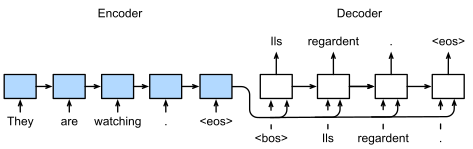
Sequence-to-Sequence (Seq2Seq): Utilizes an Encoder-Decoder framework.
-
Encoder: Processes input using RNNs, LSTMs, or GRUs to create a fixed-length “context vector.”
-
Decoder: Generates the response token-by-token based on that vector.
-
-
Attention & Transformers: Replaces sequential processing with self-attention, allowing the model to focus on specific relevant parts of long conversations, solving the memory bottlenecks of older RNNs.
Advantages and Challenges
-
Benefits: Joint optimization of the entire network, elimination of handcrafted rules, and high adaptability to new domains.
-
Limitations: Tendency to generate “bland” responses (e.g., “I don’t know”) and lack of long-term semantic consistency.
-
Solutions: Using persona vectors for identity consistency and Maximum Mutual Information (MMI) to encourage more diverse and interesting vocabulary.
2. Discuss different techniques used in retrieval-based dialogue systems
Instead of “writing” a response from scratch, these systems act as intelligent search engines, selecting the best match from a pre-existing database.
Matching Techniques
-
Single-Turn Matching: Encodes the current query and candidate responses into vectors to calculate a similarity score.
-
Multi-Turn Matching: Incorporates dialogue history. The system encodes previous utterances alongside the current input to ensure the selected response fits the broader context.
-
Optimization Ranking: Algorithms are specifically trained to rank candidates based on predicted human satisfaction ratings rather than just keyword similarity.
Hybrid Approaches
-
Retrieve-and-Refine: A sophisticated blend where a retrieval system finds a factual “base” response, and a generative model polishes it.
-
Refinement: This ensures the output is both factually grounded (from the database) and conversationally fluid (from the generator).
Pros and Cons
-
Pros: Responses are always grammatically correct, detailed, and safe (pre-vetted).
-
Cons: The system is “closed-world”—it cannot discuss anything not already present in its corpus.
3. Discuss major problems in Reinforcement Learning for POMDP-based dialogue systems.
Reinforcement Learning (RL) within a Partially Observable Markov Decision Process (POMDP) framework is mathematically robust for handling noise, but difficult to implement at scale.
Computational & Data Hurdles
-
Tractability and Scalability: As the number of user goals increases, the “state space” explodes. Calculating the exact “belief state” (the system’s confidence in what the user wants) becomes computationally impossible.
-
Data Scarcity: RL requires millions of trials to learn a policy. Since human data is expensive, designers use User Simulators, which often fail to mimic the complexity of real human behavior.
Design & Operational Issues
-
Reward Design (Reward Hacking): It is hard to mathematically define a “good” conversation. If a model is rewarded for speed, it might learn to “hack” the system by hanging up on users to achieve the shortest possible interaction.
-
The Black Box Problem: Decisions made by an RL-trained policy are often opaque. This lack of transparency makes it difficult for engineers to troubleshoot specific errors or guarantee consistent behavior in commercial environments.
4. Explain evaluation metrics for task-oriented dialogue systems
Task-oriented dialogue systems are evaluated based on their efficiency and effectiveness in helping users achieve specific goals. Evaluation metrics fall into several distinct categories:
Overall Quantitative Metrics
These objective metrics are calculated directly from system logs to measure success and efficiency:
- Task Success: Often measured using the Kappa Coefficient, which evaluates whether the system achieved the goal while accounting for pure chance.
- Dialogue Efficiency: Measured through dialogue duration, turn count, and time-to-task.
- Commercial Metrics: Includes the containment rate (percentage of calls handled without transferring to human agents), correct transfer rate, and abandonment rate.
Sub-Component Metrics
For modular systems, metrics isolate the performance of individual components to solve the “credit assignment problem”:
- Automatic Speech Recognition (ASR): Evaluated using Word Error Rate (WER).
- Natural Language Understanding (NLU): Measured via intent classification and entity extraction using Precision, Recall, and the F1-Score.
- Dialogue Management (DM): Evaluated by the correction rate, which tracks how many turns were needed to fix a misunderstanding.
- Natural Language Generation (NLG): Assessed for informativeness and naturalness.
Qualitative Metrics
These subjective metrics gauge user perception, typically relying on Likert scale questionnaires:
- SASSI: The Subjective Assessment of Speech System Interfaces measures user perceptions across six scales: system response accuracy, likeability, cognitive demand, annoyance, speed, and habitability.
Comprehensive Frameworks
- PARADISE: A unified evaluation framework that predicts User Satisfaction by using multiple linear regression to balance the trade-offs between maximizing task success and minimizing costs (such as dialogue length and user effort).
5. Explain about Retrieval-Based Response Generation
Retrieval-based response generation selects the most appropriate reply from a predefined database or dialogue corpus rather than generating new text word-by-word.
- Single-turn matching: The system encodes the user’s input and candidate responses into vectors, then computes a matching score using a ranking algorithm to find the best fit.
- Multi-turn matching: For extended conversations, the system encodes the current input and previous utterances into a comprehensive context vector. Candidate responses are encoded into response vectors, allowing the system to select a reply relevant to the entire dialogue context.
- Optimization: Algorithms can be explicitly trained to rank various retrieved outputs to optimize for higher human user ratings.
Advantages and Limitations
- Pros: Since responses are pre-defined, they are guaranteed to be grammatically correct, highly detailed, safe, and easily customizable by system designers.
- Cons: The primary limitation is that these systems cannot handle entirely new or unseen topics outside their existing datasets.
Hybrid Ensemble Models
To overcome the limitations of strictly retrieval-based or generative models, modern conversational AI often combines both.
- Retrieve-and-Refine: In this approach, a retrieved response is not output directly to the user. Instead, it is added to a generative model’s input sequence.
- Refined Output: The generator refines this input to produce a natural reply, successfully blending the detailed facts of the retrieved response with the conversational flexibility of generative models, which helps avoid dull or repetitive answers.