4.2.1 Introduction to Web Networks
-
The World Wide Web (WWW) is the largest machine-readable network graph on Earth.
-
Graph Components:
-
Vertices (Nodes): Individual web pages.
-
Edges (Ties): URL hyperlinks connecting one page to another.
-
-
Organizational Web Presence: While “Web 2.0” (social media) is vital, the “Web 1.0” or static web presence remains the primary medium for building corporate or institutional identity.
-
Key Insight: Unlike other social media networks that link people, hyperlink networks primarily link organizations and institutions.
-
Business Value: Analyzing these networks reveals how an organization’s online position matches its offline brand presence and provides ethical competitive intelligence.
4.2.2 Theory and Methodology of Hyperlinking
4.2.2.1 The Theory of Hyperlinking
Hyperlinks act as a form of “web currency.” There is no single theory for why sites link to each other, but common motivations include:
-
Authority and Endorsement: A link acts as a “vote” of confidence or credibility.
-
Trust: Reflects a reliable relationship between two entities.
-
Alliance Building: Creating a “critical mass” for a shared message or viewpoint.
-
Negative Affect: Linking to a site specifically to criticize it.
Visibility vs. Retrievability
-
Retrievability: An absolute concept. A site is retrievable if its server is operational.
-
Visibility: A relative concept. Visibility is determined by the number of inbound links from other relevant, high-ranking sites.
4.2.2.2 Methodological Issues
Analyzing hyperlink networks requires defining three parameters:
-
Nodes: Are they pages or entire websites?
- Meta-nodes: Analysts often group pages from a single hostname or subdomain into one vertex to represent an entire organization.
-
Ties: Are the edges directed or undirected?
- Weighting: Can be based on the number of links between sites or the “depth” of the link within the site structure.
-
Boundaries: The web is “borderless,” making it hard to define where a network ends.
- Snowball Sampling: Starting with a set of “seed sites” and crawling outward to discover the surrounding network.
4.2.3 The VOSON Data Provider
-
Definition: A NodeXL plug-in (Virtual Observatory for the Study of Online Networks).
-
Function: It provides a front-end for a web crawler that extracts hyperlinks and uses the Yahoo! API to find inbound links to specific sites.
-
Significance: It allows non-programmers to conduct complex web-crawling and network analysis tasks within the familiar Excel interface.

4.2.4 Practical Example 1: The Ego Network
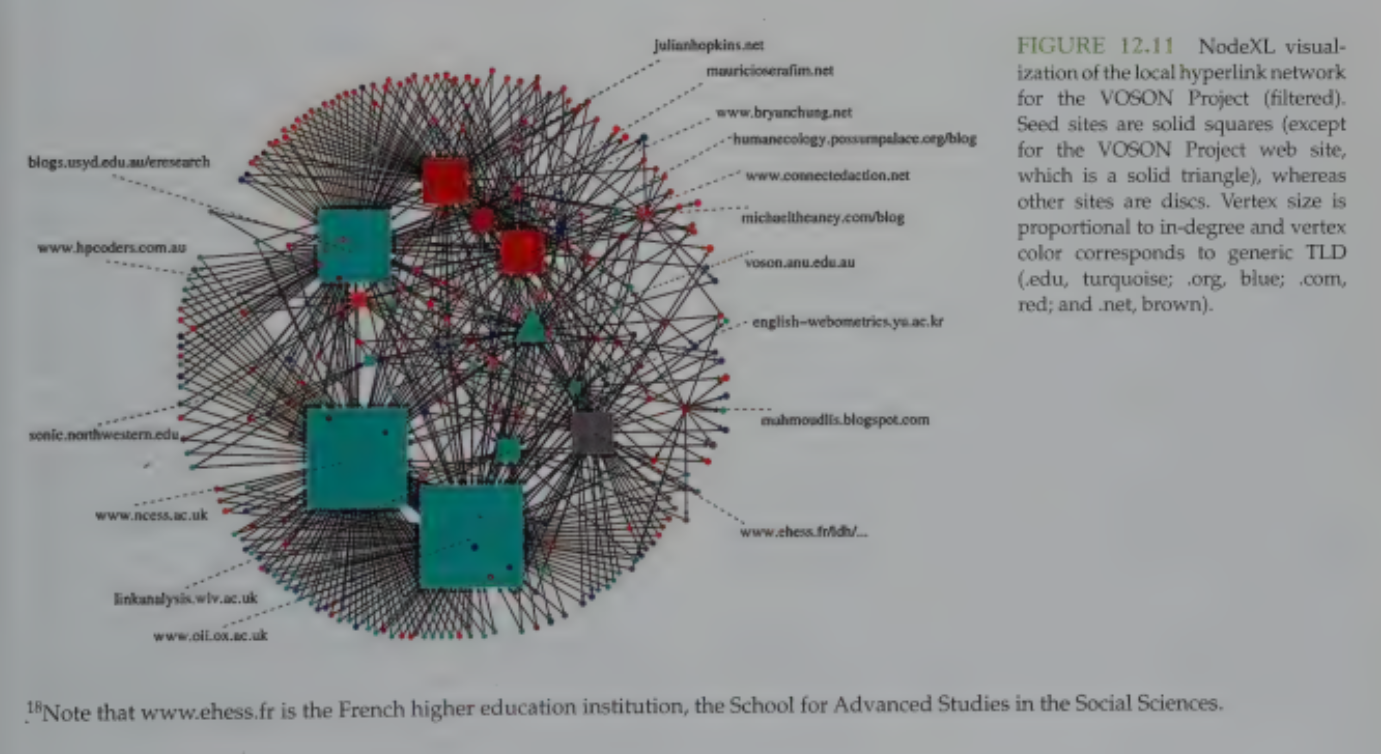
This explores who links to a specific organization (using the VOSON Project site as the “Ego”).
The Process:
-
Seed Sites: Input the URL of the target organization.
-
Crawl Parameters: * Inbound Crawl: Finding who links to you.
- Outbound Crawl: Finding who you link to.
-
Analysis of TLDs (Top-Level Domains): * Mapping vertex colors to TLDs (e.g., .edu, .com, .org) reveals the diversity of an organization’s connections.
Managing “Topic Drift”
-
Topic Drift: As you crawl deeper, the network can “blow up” with irrelevant sites (e.g., a relevant blog linking to a random cooking site).
-
The Solution: Create a subgraph containing only “important sites”—defined here as sites with an undirected degree (meaning they are connected to at least two other sites in your target network).
4.2.5 Practical Example 2: Mapping a Field/Industry
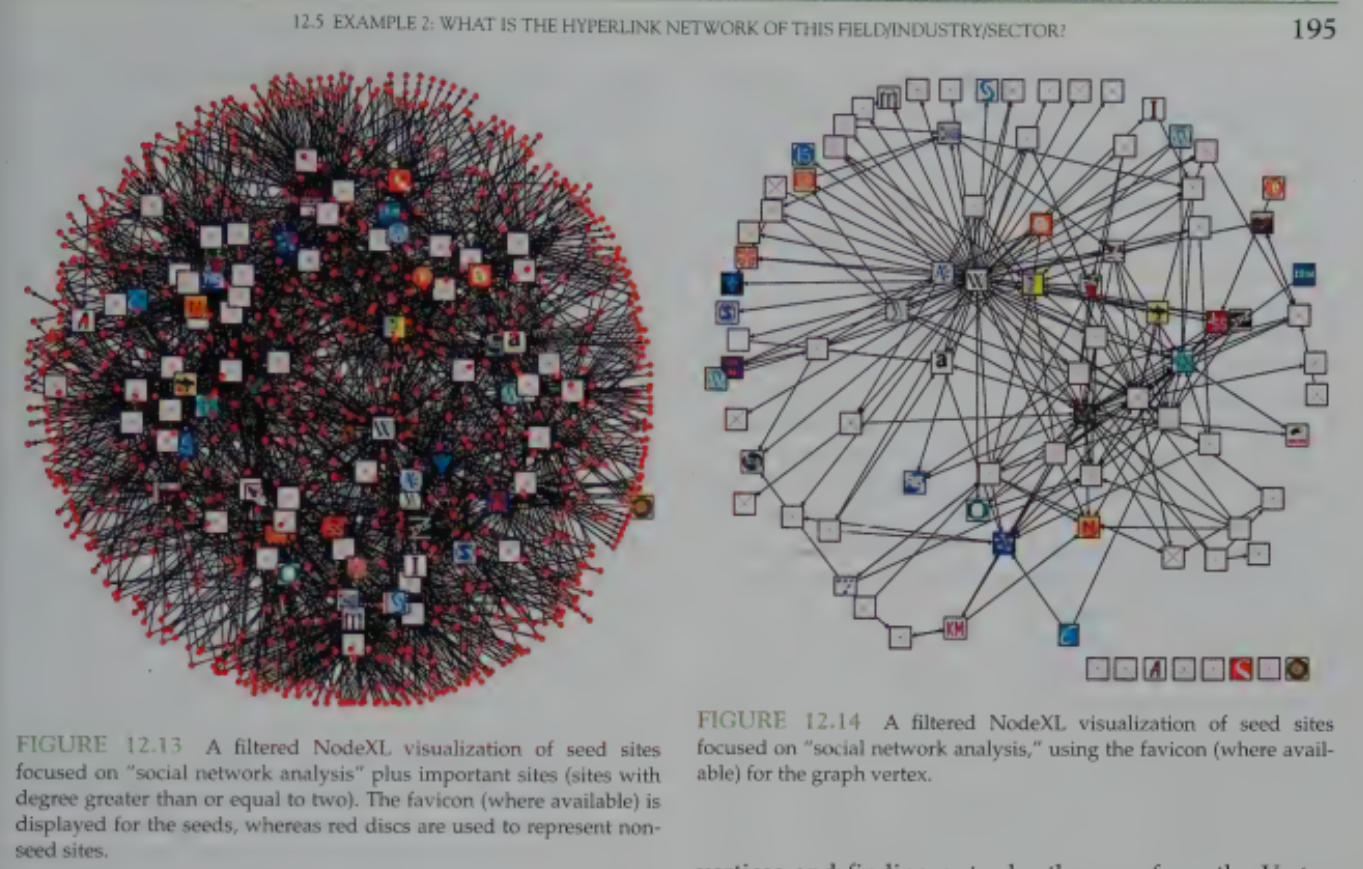
Instead of an ego network, this maps an entire sector (e.g., “Social Network Analysis software”).
Key Findings:
-
Central Actors: Sites like INSNA or software providers (UCINET, Pajek) appear with high in-degree (authority) because many others link to them.
-
Hubs vs. Authorities (Kleinberg’s Theory):
-
Authorities: Provide specialized, high-value information (e.g., software distributors).
-
Hubs: Sites that provide organized lists of links to authorities (e.g., Wikipedia, Answers.com).
-
-
Actionable Insight: If a top-ranked site in your industry does not link to you, submitting a request for a link can significantly increase your traffic and search engine ranking.
4.2.6 Advanced Topics: The “Holy Grails”
-
Blog Networks: Much more complex than static sites because they require longitudinal data (links at specific time points) and the distinction between permalinks (in body text) and blogrolls (side lists).
-
Dynamic Network Analysis: Answering “How did the network get this way?” by looking at archived data (e.g., from the Internet Archive).
-
Network Flow: Measuring the actual volume of traffic moving along the “pipes” (hyperlinks), which usually requires access to private web logs or expensive third-party data (e.g., Alexa, Hitwise).
4.2.7 Practitioner’s Summary
-
Measuring Success: Use NodeXL to identify the leaders in your industry and emulate the structure of their hyperlink network.
-
Strategy: * If you want to be a Hub, find the best Authorities to link to.
- If you want to be an Authority, identify the top Hubs and request they link to you.
-
Caveat: Always verify automated data with domain knowledge. “Garbage in, garbage out” applies heavily to web crawling.
4.2.8 Researcher’s Agenda
-
E-Government: Researching the “nodality” (central position) of government sites in social and informational networks.
-
Network Ethnography: A promising area combining quantitative hyperlink analysis with qualitative methods to understand the meaning behind the connections.