View PDF
SNA YouTube
5.1.1 Introduction
Scope: Hundreds of millions of people upload billions of videos.
Core Goal of SNA on YouTube: To visualize connected landscapes of videos and users to highlight patterns of producers, commentators, and consumers.
Significance: Online video sharing has shifted from a solitary, technical task to a mainstream social practice. Popularity is not uniform; different types of content generate different network structures.
5.1.2 What Is YouTube?
History: Created in 2005; acquired by Google in 2006.
Statistics (as of Oct 2009):
Over 1 billion videos watched daily.
Between 21% and 23% of all internet users visit YouTube monthly.
24 hours of video uploaded every minute.
Success Factors:
Ease of Use: Simple uploading and instant playback (no proprietary player installations).
Strategic Collaborations: Partners with studios, networks, and political parties.
Social Integration: Code embedding allows videos to be shared across blogs, wikis, and social media, driving “viral” growth via electronic word-of-mouth.
5.1.3 YouTube’s Structure
YouTube maintains a clear distinction between Videos (Content) and Users (Community), though they are closely linked.
5.1.3.1 Videos
Every video has a standardized page containing:
Metadata: Title, author, description, tags, and category.
Statistics: View counts, ratings, and geographical popularity maps.
Interaction Tools:
Textual Comments: Can be threaded or flagged as spam.
Video Responses: A video directly linked to the original.
Ratings: Like/Dislike buttons.
Related Videos: Generated by YouTube’s algorithm based on commonalities and user paths.
5.1.3.2 Users’ Channels
User profiles (“channels”) act as hubs for:
Personal Info: Name, age, location, and social media links.
Explicit Networks:
Subscribers: Directed, asymmetric ties (following a channel).
Friends: Bilateral, symmetric ties (requires mutual approval).
Widgets: Customizable boxes for activity logs, playlists, and “favorited” videos.
5.1.4 Networks in YouTube
5.1.4.1 Video Networks
Shared Descriptors: Edges connect videos sharing the same tags or categories.
Video Responses: Direct links between a response video and the source.
Comment Networks: Edges connect videos commented on by the same user.
5.1.4.2 Users’ Networks
Explicit: Subscription and friendship lists.
Implicit: Created via interactions like commenting on a channel profile, rating, or favoriting.
5.1.5 Key Analytical Questions
Centrality: Which videos/users lead a category? Who are the “rising stars”?
Groups: Do videos form dense hubs based on niche interests (e.g., Japanese anime, makeup)?
Temporal: How does a viral video disrupt or reinforce existing networks?
Structural: What are the differences between a user’s subscription network (fans) and friendship network (peers)?
5.1.6 Importing YouTube Data into NodeXL
5.1.6.1 Video Data
Import Method: Search by keywords (e.g., “makeup”).
Edge Types: Tags, shared commenters, or video responses.
Limitation: Searches titles/metadata, but not the actual audio/video content.
5.1.6.2 User Data
Import Method: Search by exact channel name.
Levels:
1.0: Direct neighbors.
1.5: Direct neighbors and the ties between them.
2.0: Includes friends-of-friends.
5.1.6.3 - 5.1.6.4 Technical & Ethical Issues
Privacy: If a user marks lists as private, NodeXL cannot retrieve them.
API Reliability: Web requests may time out, leading to inconsistent data.
Ethics: Researchers must handle personally identifiable info (faces + names + opinions) with care to avoid embarrassment or disclosure of sensitive data.
5.1.8 Case Studies: Analyzing YouTube Networks
5.1.8.1 User Networks: Celebrity vs. Community
The text compares two different types of prominence:
Rihanna (Celebrity): * Structure: A “star” network.
Metrics: Extremely sparse (Density: 0.008).
Behavior: The channel is a promotional showcase; fans connect to Rihanna but not to each other.
Leesha Harvey (Folk Singer):
Structure: A cohesive community.
Metrics: High density (0.166).
Behavior: Features multiple hubs of mutual friends and folk-genre enthusiasts who support one another.
5.1.8.3 The “Makeup” Video Network
Finding: shared-tag networks are very dense. Filtering by Edge Weight (frequency of shared tags) is necessary to see patterns.
Boundary Objects: The “Natural makeup” video had the highest Betweenness Centrality. It acted as a “bridge” between everyday makeup users and theatrical/alternative makeup communities.
Note: The most central videos (pivotal to the community) were not necessarily the most popular (most viewed) in the global YouTube population.
5.1.8.4 Healthcare Reform Networks
Controversy vs. Popularity: High comment counts did not correlate with high ratings. Controversial videos sparked “heated discussions” but received lower ratings from dissenters.
Central Players: Satirical news (e.g., The Young Turks) and snippets of politicians (e.g., Mike Rogers) generated more prolonged and lively discussion than informational or personal vlogs.
5.1.9 - 5.1.10 Summary & Agenda
Practitioners: SNA helps gauge public trends and decide which “creative routes” maximize outcome while avoiding backlash.
Researchers: YouTube research is in early stages compared to Twitter/Facebook. The key is the interplay between content and structure—how the web of social ties determines what becomes popular.
Exam Tip: Be prepared to define Boundary Objects and explain why Rihanna’s network is a “star” structure (low density) while a niche community like folk music has high density.
Link to original


Wiki Networks
Connections of Creativity and Collaboration
5.2.1 Introduction to Wikis
Definition: A wiki is a website that allows any user to edit content, where every modification is recorded and archived.
Origin: Invented by Ward Cunningham in 1995 (WikiWikiWeb). “Wiki” means “quick” in Hawaiian.
Significance: Wikis challenge traditional notions of authority and expertise by enabling massive collaborative knowledge construction (e.g., Wikipedia).
Use Cases: Knowledge repositories for companies, lesson plans for teachers (Classroom 2.0), medical information sharing, and fan communities (Lostpedia).
Technical Nature: Wikis are one of the most demanding social media systems to analyze due to large data volumes, complex page types, and various interaction modes.
5.2.2 Key Features of Wiki Systems
Wikis (specifically those using MediaWiki software) have several structural pillars:
History: The “iceberg” of activity. Every edit records the editor, time, description (summary), and specific changes.
Namespaces: Organizational categories that separate different types of work:
Main/Article: The actual encyclopedic or topical content.
Talk/Discussion: Threaded spaces for editors to coordinate edits and resolve disputes without affecting the article content.
User: Personal pages for registered contributors.
User Talk: Pages for direct user-to-user communication.
Wikipedia/Project: Policy debates and community governance.
Everything is a Page: Collaborative tasks are not just for articles; policies, categories, and templates are all pages that evolve through community edits.
User Accounts: While anonymous editing is often allowed, accounts allow for the tracking of “User Contributions” and the building of reputation.
5.2.3 Wiki Networks from Edit Activity
Translating wiki activity into a network graph requires defining vertices, edges, and attributes:
5.2.3.1 Defining the Network Components
What is a Vertex? Usually an individual User ID. It can also be a Page or a Category if studying content relationships.
What counts as an Edge?
User Talk Edits: Editor A edits User B’s talk page (direct communication).
Article Talk Replies: Editor A replies to Editor B in a discussion thread.
Co-editing: Two users edit the same page (shared interest/attention).
What Attributes matter? Proportion of “minor” edits (grammar) vs. “major” edits (content), total edit volume in bytes, and specific topics of interest.
Table: Primary Wiki Network Types
Network Type Vertices Edge Definition Page Link Pages Hyperlinks between pages User Talk Users Comments on another user’s profile User Discussion Users Replies on an Article Talk page Affiliation (Bimodal) Pages & Users User edits per page User Co-edit Users Users who have edited the same pages
5.2.4 & 5.2.5 Identifying Social Roles (Project Castle Case Study)
This study used data from the Empire Wiki to identify different types of editors based on their network signatures.
5.2.4.1 Social Roles and Subgraph Analysis
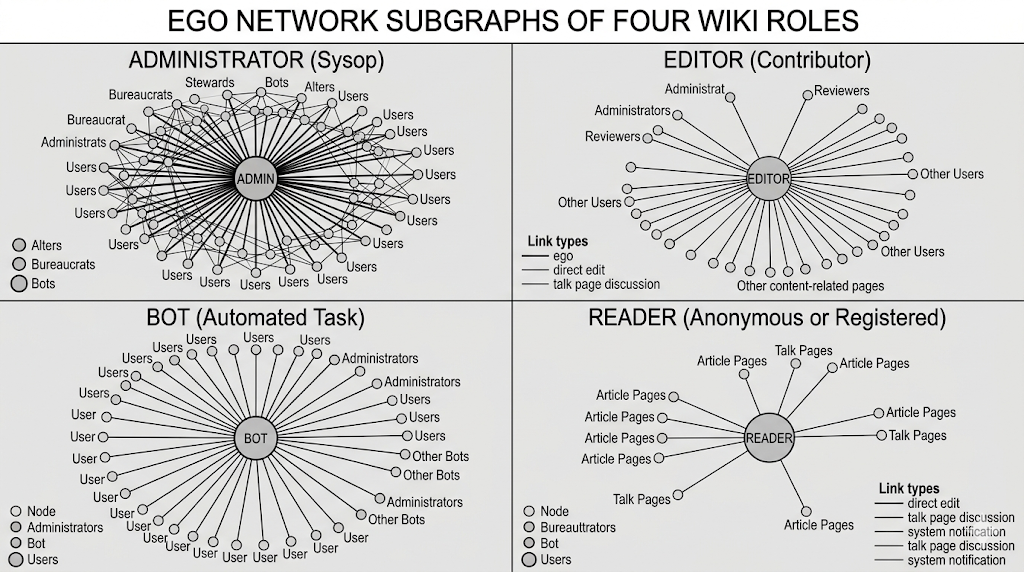
By creating 1.5-degree ego networks (the user and their neighbors, plus connections between those neighbors), researchers identified four distinct types of participants:
Type 1 Sysop (Administrator): * Network Role: The “public face” of administration.
Structure: High degree of ties to users who are not connected to each other.
Function: Bridges the “outer ring” (general community) to the “inner core” (senior staff).
Type 2 Sysop (Senior Administrator):
Network Role: Internal coordination.
Structure: Smaller number of overall ties, but those neighbors are densely interconnected.
Function: Embedded in a tight core of other senior admins; less direct community interaction.
Active Participant (Substantive Expert):
Structure: High project-specific edits but very low overall network ties.
Behavior: Works autonomously on specific content without much general community integration.
Inactive Participant:
- Structure: Well-embedded in the general network but uninvolved in the specific project (e.g., Project Castle).
5.2.6 Deliberation in Article Talk Pages
This example explores the quality of discussion and how “structural signatures” identify helpful vs. harmful contributors.
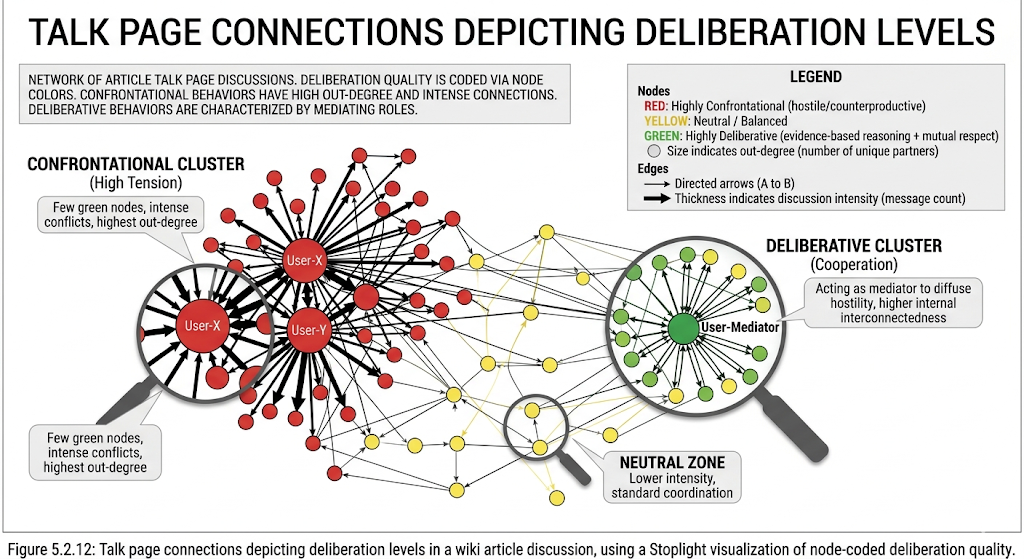
Metric: Deliberation quality (evidence-based reasoning + mutual respect).
Stoplight Visualization (NodeXL):
Green: Highly deliberative/collaborative.
Red: Confrontational (hostile/counterproductive).
Yellow: Neutral or balanced.
Findings: * Confrontational users often have the highest out-degree (talking at many people) and form the most intense (thickest) dyadic ties.
- Deliberative users tend to have fewer partners and act as mediators to diffuse hostility.
5.2.7 Large-Scale Structure (Lostpedia Case Study)
Lostpedia (fan wiki for the show Lost) was used to demonstrate how to map hundreds of thousands of edits.
5.2.7.1 Page-to-Page Co-edit Networks
Logic: A link exists between Page X and Page Y if a significant number of people edited both.
Insight: Found a clear cluster of “Theorists” who edit “Theory” pages almost exclusively, separate from those who edit “Article” or “Discussion” pages.
5.2.7.3 Normalization of Data
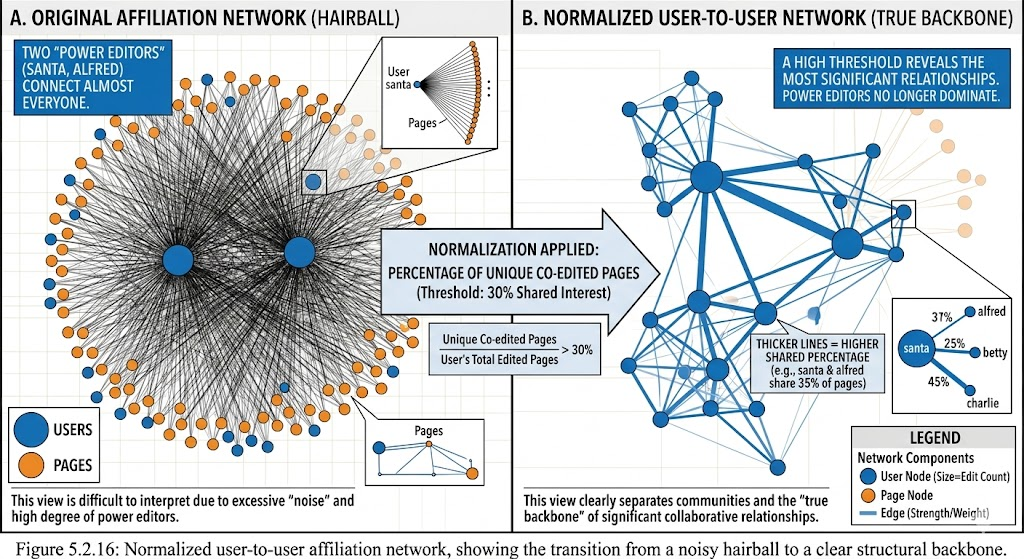
The Problem: Power editors (like the example “Santa”) edit so many pages that they connect to everyone, creating a “hairball” graph.
The Solution: Use percentages instead of raw counts.
Formula: .
Result: A higher threshold (e.g., minimum 30% shared interest) reveals the most significant relationships and the true “backbone” of the community.
5.2.8 - 5.2.10 Summary for Practitioners and Researchers
For Practitioners: Wiki analysis is “advanced” because there are no automatic spigots for everything. You must “roll your own” data via web scraping or SQL parsing. Success depends on narrowing the sampling frame (focusing on a specific project or time period).
For Researchers: Wikis are the best settings to study the diffusion of norms and the dynamics of cooperation because the temporal history is perfectly preserved.
The “Everything is an Edit” Rule: In wikis, communication is editing. There is no separate message system; coordination happens through the content creation tools themselves.
Link to original